
Canada exports goods and services to dozens of trading partners every year, and these flows account for a substantial share of its gross domestic product. But the prosperity generated by this trade is not evenly distributed: it depends on the type of product exported, the number of businesses involved in trade, and how geographically concentrated the target markets are.
Value added by Canadian exports: goods and services are not equal
A figure published by Export Development Canada sheds light on an imbalance that is rarely highlighted. In 2023, every dollar of services exported contributed about 86 cents to Canada’s GDP, compared with 69 cents for every dollar of goods exported. The gap may seem modest at first glance, but when applied to the billions of dollars traded each year, it changes how we assess the real prosperity generated by trade.
Goods exports (oil, minerals, agricultural products, automobiles) still dominate in volume. However, their contribution to GDP per dollar is lower because they involve more imported inputs, logistics costs, and energy. Commercial services, by contrast, rely primarily on skilled labour and intellectual property based in Canada.
This raises a strategic question: a country seeking to increase the wealth retained within its borders has reason to develop its services exports at least as much as its resource exports. Yet Canada’s international trade is still largely viewed through the lens of raw materials and manufactured goods.
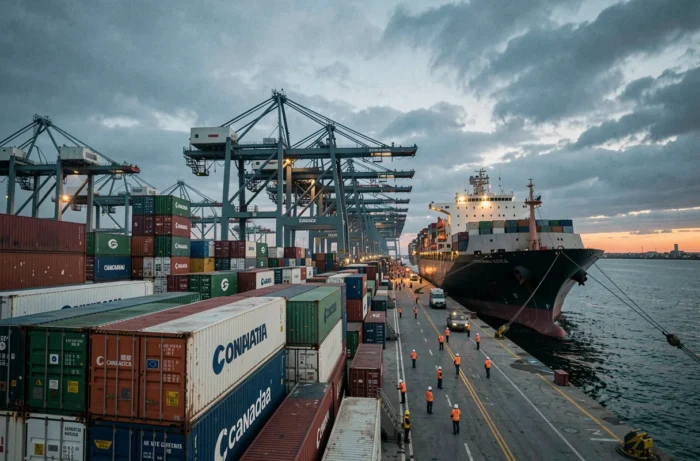
Export market concentration: the weight of the United States and uncertainty surrounding CUSMA
The United States absorbs the majority of Canada’s goods exports. This geographic and regulatory proximity has long ensured predictable access to the U.S. market, but the situation is changing.
Following the joint review of CUSMA on July 1, 2026, the United States did not agree to extend the agreement for a new 16-year term. The agreement remains in force until 2036, but the decision ushers in a period of annual reviews. For Canadian businesses planning investments over several years—factories, supply chains, long-term contracts—this uncertainty makes decision-making more difficult.
The risk is not an immediate breakdown in trade, but a gradual freeze on the most ambitious projects. A company weighing whether to invest in Canada to export to the United States or set up directly on U.S. soil may favour the latter option if market access conditions become unpredictable from one year to the next.
Services as a driver of geographic diversification
Canadian services exports have a different geographic profile from goods exports: they are less concentrated in the United States. This makes them a potential tool for diversification. For example, Canadian goods exports to Europe rose by 33%, according to data reported by EDC in 2025, suggesting that other markets are gaining ground.
Large companies and exporting SMEs: who really benefits from international trade?
The prosperity generated by trade also depends on how its gains are distributed among businesses. Two figures are worth considering together.
- In 2024, SMEs accounted for nearly half of services exports, compared with about 40% of goods exports. Services therefore offer a more accessible entry point for smaller businesses.
- The 33% increase in export volumes to Europe was accompanied by only a 1% rise in the number of establishments exporting to that market. Trade growth is driven mainly by businesses already active internationally, not by a broader base of exporters.
- This concentration means that the economic benefits—jobs, income, and local investment—are spread less widely across the economy than the headline figures might suggest.
Rising export volumes can mask a more complex reality: if the gains are concentrated among a few dozen large companies, national prosperity measured in aggregate does not automatically translate into a higher standard of living for the entire workforce.
International trade and employment in Canada: beyond the headline figures
Services exports draw on expertise in consulting, information technology, engineering, financial services, and education. These sectors generate high-value-added jobs that often pay more than the national average.
The contribution of 86 cents to GDP for every dollar exported in the services sector reflects precisely this reliance on skilled labour. When a Canadian firm sells a consulting engagement to a foreign client, almost all of the amount invoiced goes toward salaries, office rent, and local purchases. The money stays in Canada.
Goods follow a different pattern. An exported tonne of crude oil generates revenue, but a significant share goes toward extraction, transportation, and imported inputs. Proportionally, less value is retained in Canada.

Limitations of this analysis
Available data do not make it possible to break down precisely, sector by sector, the share of export revenue that translates into direct jobs in each province. GDP contribution per dollar exported is an aggregate indicator that says nothing about the detailed geographic or sectoral distribution of the benefits.
Similarly, the figure of 86 cents per dollar for services covers very different activities: a management consulting contract and a data processing service do not have the same employment profile or the same local value added.
International trade remains a pillar of Canadian prosperity, but its real contribution depends less on the total volume traded than on three factors: the nature of the products exported (services or goods), the number of businesses actually involved in trade, and the stability of market access conditions in partner countries. On all three fronts, Canada’s current position has both strengths and vulnerabilities that headline export figures alone cannot capture.