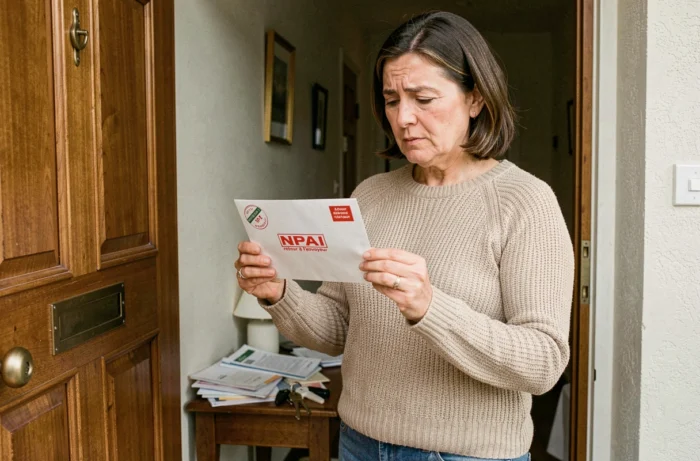
Every year in France, millions of items of mail marked NPAI (N’habite Pas à l’Adresse Indiquée, or “Not at the Address Indicated”) pass between mailboxes and post offices. The legal framework governing this mail is based on Article 226-15 of the French Criminal Code, which protects the confidentiality of correspondence.
For a new resident receiving mail addressed to a former occupant, the options are limited: opening, throwing away or destroying mail that is not addressed to you is a criminal offence. Understanding the return procedure and its limits helps avoid both legal trouble and a buildup of unwanted mail.
NPAI mail and registered mail: two different procedures
Most online guides explain how to return an ordinary letter. Registered mail and delivery notices addressed to a former occupant follow a different process, one that is often overlooked.
A new resident must not collect registered mail from the post office counter, even if the address is correct. Collecting it would mean taking possession of mail for which you are not the intended recipient. The recommended approach is not to go to the post office and to let the holding period expire. The item will then be returned automatically to the sender marked NPAI.
If a delivery notice has been left in your mailbox, the best practice is to hand it directly to the mail carrier or drop it off at the post office, explaining that the person no longer lives at that address. This distinction between ordinary and registered mail changes the practical steps to follow, and confusing the two can cause complications with the sender.
A detailed guide explains how to return NPAI mail, distinguishing between each type of item so you can take the right action based on the format you received.

Returning NPAI mail through La Poste: practical steps
For an ordinary letter, the process takes just a few steps, but every detail matters to ensure La Poste handles the item correctly.
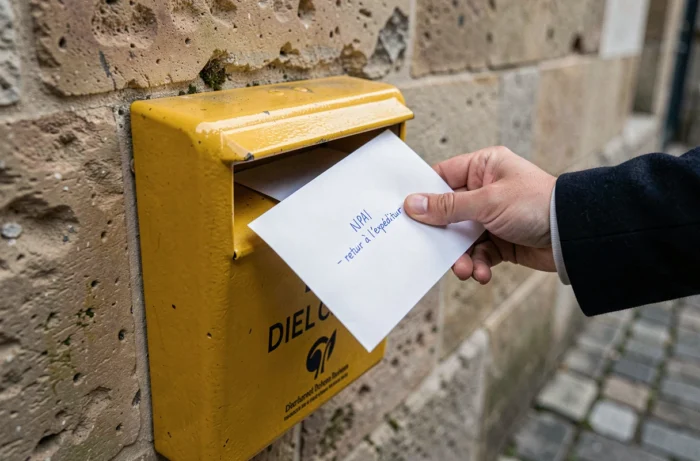
- Cross out the recipient’s address without opening the envelope, then clearly write “NPAI – Not at the address indicated” or “Return to sender.”
- Put the item in a yellow La Poste mailbox or hand it to the mail carrier on their rounds. No additional postage is required to return ordinary mail this way.
- If you receive a large volume of mail, report the situation directly to your local post office and ask them to add a note to the address for the name in question.
Never open the envelope, even to identify the sender and let them know about the mistake. The confidentiality of correspondence applies regardless of the reason.
Name label on the mailbox: an underrated solution
Putting your name on the mailbox is about more than convenience. It is the first signal the mail carrier uses to identify the legitimate recipients at an address. Without a label, mail is sorted based solely on the address, and anything bearing the correct street number will be delivered, regardless of the name.
An up-to-date name label significantly reduces the amount of NPAI mail you receive. It helps the mail carrier immediately spot items addressed to someone who no longer lives there and return them without delivering them.
Remember to remove old names if you can access the label holder. In a condominium, you can ask the property manager to update the standardized mailboxes.
Mail forwarding after a move: a temporary solution
La Poste’s mail forwarding service is often presented as a miracle solution for former occupants. However, it has limitations that new residents should understand to see why mail sometimes continues to arrive.
Limited duration and restricted renewal
Six-month domestic mail forwarding can be renewed once, but it cannot be renewed indefinitely. After this period, mail that has not been redirected will go back to the old address if the sender has not been notified of the change.
Mail forwarding does not update the records held by banks, government agencies or service providers. It redirects physical mail for a set period without fixing the underlying problem. The former occupant must notify each organization individually or use Service-Public.fr’s change-of-address service to notify several government agencies in a single step.
People left off the forwarding agreement
One point that is rarely mentioned: only people named in the mail forwarding agreement are covered by the service. A roommate, household member or former spouse whose name was not added will continue to receive mail at the old address. For the new resident, this explains why some names keep appearing on mail while others have stopped.
Mail keeps arriving despite NPAI returns: what to do when nothing works
Returning mail deals with each item individually. It does not fix the underlying cause: the incorrect address in the sender’s records. When the same type of mail keeps coming back week after week, returning it alone is no longer enough.
The next step is to report the problem directly to the identifiable sender (visible on the envelope without opening it, through the logo or return address). A letter or call to the sender’s customer service team explaining that the person no longer lives at this address can help correct the records at the source.
For addressed advertising mail, the Robinson list for mail or a direct request to the advertiser can help reduce deliveries. Unaddressed flyers are covered by a different scheme (the Stop Pub sticker) and are not subject to the NPAI procedure.
Returning NPAI mail remains the basic response to every item delivered by mistake. Combined with a clear name label and reports to repeat senders, it will eventually dry up the flow within a few weeks. The only factor the new resident cannot control is how promptly the former occupant updates their contact details with the people and organizations they correspond with.