
In everyday French, the children of your first cousin are called little cousins or little cousins. This seemingly simple term hides several subtleties depending on the type of cousinship that connects you to their mother, whether you think in genealogical or legal terms, and according to the actual family configuration.
Little cousin, first cousin once removed: two terms for two perspectives
The most common confusion arises from the fact that the vocabulary changes depending on who is speaking. For you, the child of your first cousin is your little cousin. But for your own children, that same little cousin becomes a first cousin once removed.
The difference lies in the generation. You and your first cousin belong to the same generation, with common grandparents. Her children are one generation below you in this branch. Your children, on the other hand, are in the same generation as hers, hence the term “once removed,” which refers to cousins shifted down one level from the first cousins.
Understanding the relationship with the children of my cousin therefore requires always specifying from which perspective we are speaking: yours or your children’s.

Cousin by marriage, half-cousin, distant cousin: how the relationship changes
The word “cousin” covers very different realities in everyday language. When someone says “my cousin,” it can refer to a first cousin (the child of an uncle or aunt), but also to a cousin by marriage, a half-cousin, or a relative much more distantly related than family usage artificially brings closer.
Cousin by marriage
A cousin by marriage enters the family through marriage, not through a common ancestry. If your first cousin marries someone, that person becomes your cousin by marriage. No common ancestor connects you to her or her children. In genealogy, the children she may have from a previous union are not your little cousins in the strict sense. Only the children born from the union with your cousin share common grandparents with you.
Half-cousin
A half-cousin shares only one grandparent with you instead of two. This situation arises when one of your grandparents has children with two different partners. The blood relationship exists, but it is halved compared to a classic first cousin relationship. The children of a half-cousin remain your little cousins in common usage, even if the genetic proximity is lesser.
Distant relative referred to as “cousin”
In many families, a person whose actual connection goes back several generations is called a “cousin.” This could be a first cousin (child of first cousins) or an even more distant relative. The more distant the connection with the “cousin,” the more distant the connection with her children is as well.
To clarify the ambiguity, the most reliable method is to trace back to the common ancestors and count the generations on each branch. Saying “the children of my first cousin” is much more precise than “my little cousins.”
Degree of kinship in civil law: calculation and legal implications
The emotional bond and the family designation do not always coincide with the legal degree. In French civil law, the degree of kinship is calculated by counting each generation that separates two people through their common ancestor.
Let’s take the concrete example of you and the child of your first cousin:
- From you to your common grandparents: two generations (you to your parent, then to the grandparent)
- From the common grandparents to your cousin: two generations (the grandparent to the uncle or aunt, then to the cousin)
- From your cousin to her child: one additional generation
The total gives five degrees of kinship in civil law between you and the child of your first cousin. This number has concrete consequences, particularly in matters of inheritance.
Verify the link on a family tree: the method that avoids errors
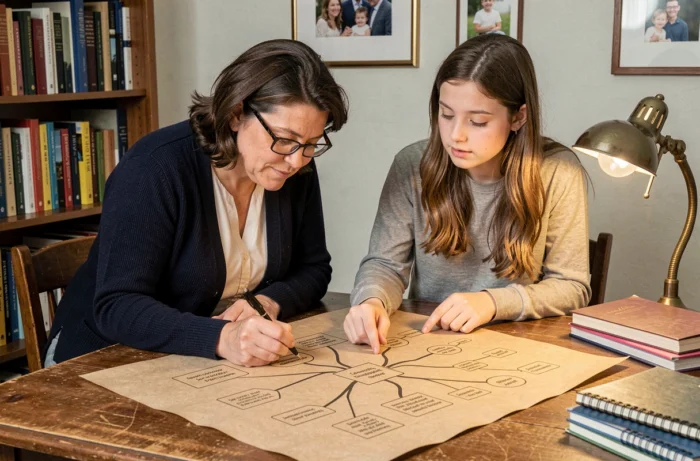
The terms “little cousin” and “first cousin once removed” do not always appear in civil status documents or genealogy software, which prefer counting by degrees. To identify the exact relationship with the children of your cousin, the safest approach remains to lay out both branches on paper or in dedicated software.
Three steps are sufficient:
- Identify the closest common ancestor (for first cousins, these are the shared grandparents)
- Count the generations between that ancestor and you on your branch
- Count the generations between that same ancestor and your cousin’s child on the other branch
If the two numbers are different, it is a cousinship shifted by one generation. Drawing the two branches of the tree remains the only way to avoid confusion between little cousin, first cousin once removed, and distant cousin.
Family vocabulary often simplifies things for convenience. Family gatherings do not require legal precision, and calling a distant relative “cousin” or “cousin” is not inherently wrong. The distinction only becomes truly useful in two cases: inheritance matters, where the exact degree determines your rights, and genealogical research, where the rigor of vocabulary conditions the reliability of the tree.