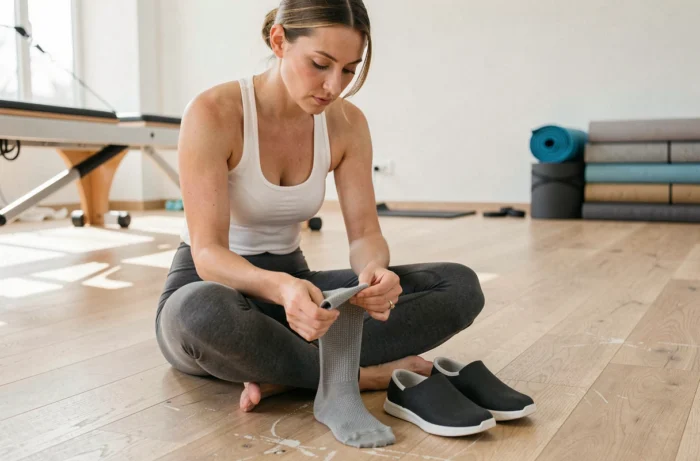
Barefoot, non-slip socks, minimalist shoes: there are plenty of options for practicing Pilates, and each class format changes the game. Comparing these three solutions based on measurable criteria (grip, freedom of movement, compatibility with equipment) allows for a decision without relying solely on studio habits.
Shoes, socks, or barefoot in Pilates: comparison table
Before detailing each option, a synthetic overview helps to situate the concrete differences between the three most common solutions.
| Criterion | Barefoot | Non-slip socks | Minimalist shoes |
|---|---|---|---|
| Grip on mat | Good (skin on rubber) | Very good (silicone nubs) | Variable depending on the sole |
| Grip on Reformer | Poor (sweat on carriage) | Very good if nubs are at the heel | Not suitable (rigid sole) |
| Proprioception | Maximum | Slightly reduced | Reduced |
| Hygiene in shared studio | Poor | Good | Good |
| Freedom of toe movement | Total | Good (open or closed models) | Limited |
This table shows a clear gap between the Reformer and the mat. On the mat, barefoot remains a viable option. On the Reformer, non-slip socks excel in grip and hygiene, two criteria that neither barefoot nor minimalist shoes cover as well simultaneously.
Several selection criteria for your Pilates shoes deserve to be explored depending on the type of session. A guide to Pilates shoes on 1 Sport 1 Coach details the models suitable for each class format.
Non-slip socks for Reformer Pilates: how the coverage of nubs makes a difference
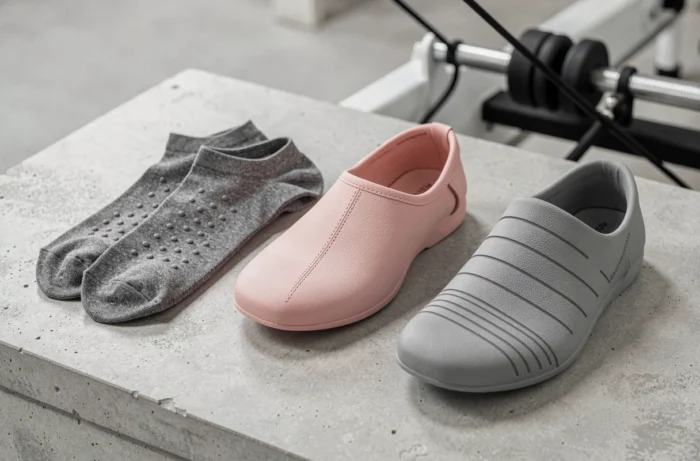
Most socks sold as “non-slip” concentrate their nubs under the front of the foot. For a yoga or Pilates class on a mat, this distribution is usually sufficient.
On a Reformer, the situation differs. The heel comes into direct contact with the bar during many exercises (footwork, presses). Absent nubs at the heel reduce grip on the Reformer bar, which forces compensation through unnecessary muscle contraction. Checking the coverage of the heel area before purchase avoids this problem.
Regular sock vs. non-slip sock: a common confusion
An ordinary cotton sock covers the foot and meets hygiene requirements in a shared studio. It does not replace a sock with silicone nubs. On the Reformer carriage, the fabric slips just as much, if not more, than a sweating bare foot.
The distinction is about grip, not hygiene. Some studios specifically require non-slip socks, while others are satisfied with recommending any pair of socks. Checking this guideline before the first session saves an unnecessary purchase or denial of access to the class.
Minimalist shoes for floor Pilates: when they are justified
Minimalist shoes regularly appear in recommendations for Pilates. Their relevance depends on the practice context, and this context is often more limited than one might think.
Limited use to hard or outdoor surfaces
On a studio floor mat, a minimalist shoe adds a layer between the foot and the mat without measurable grip gain. The sole, even if thin, reduces proprioception compared to barefoot or a thin sock. However, for outdoor practice or on a cold, hard floor (converted garage, multipurpose room), the minimalist shoe protects the foot without blocking toe flexion.
The criteria that distinguish a model suitable for Pilates from a minimalist shoe designed for running:
- No or very little drop (no elevation difference between heel and forefoot) to maintain pelvic alignment during floor exercises
- A flexible sole that bends easily in the hand, allowing for plantar flexion work
- A wide toe box that allows the toes to spread naturally during weight-bearing
Pilates on machines: shoes are rarely compatible
On a Reformer, Cadillac, or Wunda Chair, the sole of a minimalist shoe alters the sensory feedback of the foot on the bars and pedals. Instructors who use these machines almost always direct students towards non-slip socks or barefoot.
Criteria for choosing Pilates socks based on class type
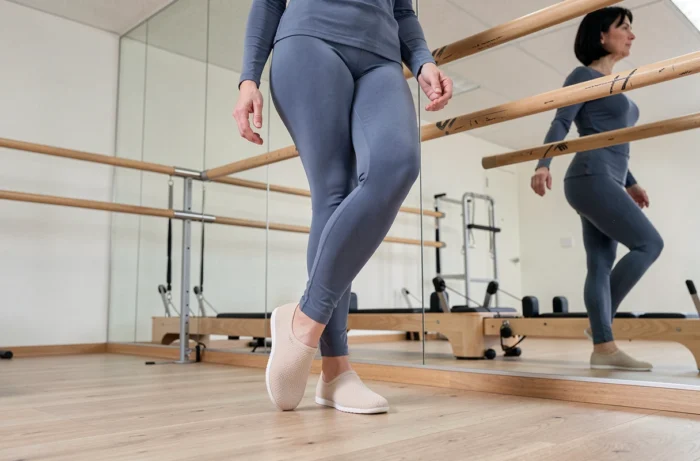
Rather than listing brands, these criteria allow for evaluating any model against your actual practice.
- Nubs covering the entire plantar surface (forefoot and heel) if you practice on Reformer or barre machines
- Open-toe model for floor Pilates classes that include toe spreading exercises (often combined with yoga)
- Closed and fitted model if the studio imposes a strict dress code or if you sweat a lot from your feet
- Quick-drying fabric for long or consecutive sessions, to prevent moisture from reducing the grip of the nubs
A often overlooked point: size. A non-slip sock that is too large forms folds under the foot, which negates the effect of the nubs. A snug fit without compression ensures direct contact between the nubs and the surface.
Barefoot in Pilates: proprioception as a decisive criterion
Pilates relies on precise control of ground contact. The arch, toes, and heel transmit postural information that the brain uses to adjust balance in real-time. Each layer added between the foot and the ground filters some of these signals.
For a practitioner specifically working on foot stability or postural rehabilitation, barefoot provides the most complete sensory feedback. The limit appears in shared studios where floor hygiene is not guaranteed, or on machines where grip becomes a safety issue.
The final choice depends less on personal preference than on the equipment used during the session. On mats, barefoot or thin socks work. On Reformer, non-slip socks with heel coverage are essential. Minimalist shoes are only justified on hard ground or outdoors, where protection takes precedence over sensation.