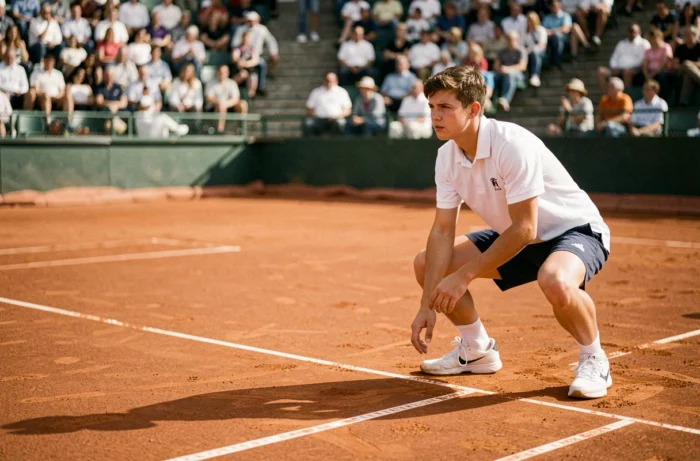
During a televised tennis match, you can see them running silently, crouching along the net or standing behind the baseline. Ball kids are part of the scenery, but their role goes far beyond simply retrieving balls. Their compensation, selection and physical preparation raise questions whose answers are rarely as simple as a single figure.
Ball kid selection and training: a demanding journey
Before stepping onto the clay courts of a tournament like Roland-Garros, candidates undergo several months of preparation. Selection is highly competitive: it begins at regional level, in clubs affiliated with the French Tennis Federation, where drills assess reaction time, coordination and the ability to stay focused for long periods.
Former ball kids often help supervise these regional selections. Their experience helps them identify candidates who can keep up with the pace of a tournament that runs for several weeks. Understanding the role of a tennis ball kid helps explain why selection is about more than running speed.
Have you ever noticed that ball kids do more than just chase after a stray ball? They have to memorize mnemonic codes, anticipate the direction of the serve and coordinate their movements with five other teammates on court. Every move is choreographed to ensure the match is never interrupted.
Preparing for long days outdoors
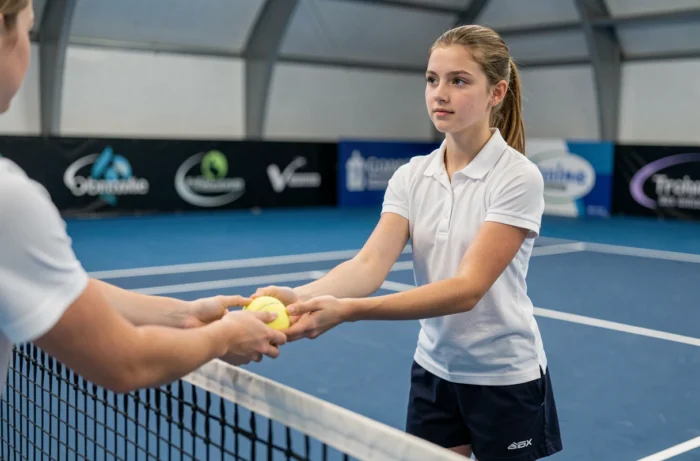
Heat endurance is an explicit selection criterion. The head of the Roland-Garros ball kids emphasizes this point: in May and June, temperatures on court can soar, and working days are long. Candidates must prove they can handle sustained physical exertion in direct sunlight.
Training includes work on posture, since crouching and then sprinting within a fraction of a second puts considerable strain on the legs and back. Clubs that train candidates organize practice sessions featuring lateral movement drills, timed ball throws and extended periods of holding a static position.
Ball kid compensation at Roland-Garros: volunteering or a salary?
Roland-Garros ball kids do not receive a salary in the traditional sense. The Paris tournament operates on a model similar to volunteering. The young people selected do not receive hourly pay comparable to that of an employee.
In return, they receive practical benefits:
- They are provided with a full kit, including an official outfit, shoes and a bag, which they get to keep after the tournament
- Meals are covered for the entire time they are on site
- An allowance or reimbursement covers travel and accommodation costs for those coming from outside the Paris region
This system explains why articles refer to a “surprising salary”: most candidates and their families expect financial compensation, whereas the real value lies mainly in the experience and the support provided.
What about other tournaments?
The model varies from one competition to another. Some tournaments on the professional circuit pay a small daily allowance. Others, like Roland-Garros, focus on prestige and the opportunity to gain valuable experience. No major tournament offers a genuine employment contract for this role, which remains a youth activity supervised by tennis federations.
What ball kids do during a tennis match
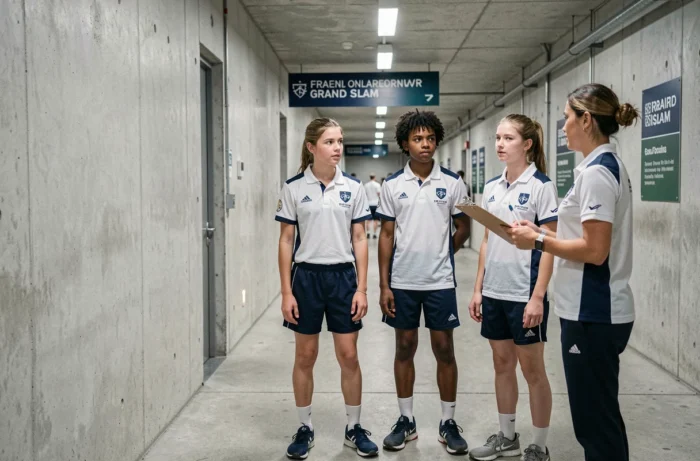
Six ball kids are positioned on court during a match: two at the net and four at the baseline. Their main task is to get the balls to the server’s side as quickly as possible after each point.
The smooth flow of play depends directly on how efficiently they do their job. A ball kid who is too slow delays the serve, while a clumsy movement can distract a player who is concentrating. Every second counts, and a supervisor at the side of the court continuously evaluates the teams.
Here are their specific duties:
- Retrieve dead balls after each rally and quickly pass them to the server
- Hand players a towel between points, in accordance with the tournament’s instructions
- Remain completely still during rallies so as not to obstruct the players’ or spectators’ view
- Rotate between positions (net and baseline) according to a schedule set in advance
Coordination relies on mnemonic codes learned during training. These silent signals let all six ball kids know who moves, when and in which direction, without ever speaking to one another.
Why young candidates want to become ball kids
Money is not the main motivation. Candidates are primarily looking to experience a tournament from the inside. Being just a few meters away from the world’s best players during an official match is an opportunity few tennis fans get to enjoy.
Being a ball kid can also strengthen a young player’s sporting résumé. For a young club player, the experience demonstrates commitment, discipline and an understanding of the game that go beyond simply competing.
Prestige is another draw: some former ball kids say the experience steered them toward umpiring, coaching or organizing sporting events.
The question of salary, so often typed into search engines, therefore obscures a richer reality. A tennis ball kid performs a technical, physically demanding role, is selected according to specific criteria, and is rewarded in experience rather than euros.