Weighted plush toys are becoming increasingly common in wellness aisles and specialist sensory equipment stores. They work by using a heavier filling (glass or plastic microbeads) that applies gentle pressure to the body when held close. The mechanism cited by manufacturers is deep pressure stimulation, an approach used in occupational therapy and psychomotor therapy.
Available clinical evidence relates mainly to weighted blankets, not plush toys. This distinction is worth making from the outset, since many claims found online apply results obtained with blankets to an object that is much lighter and targets a smaller area.
Deep pressure and weighted plush toys: what research actually measures
Deep Pressure Stimulation activates the proprioceptive system, a network of sensors in the muscles and joints that tells the brain where the body is positioned. Steady, moderate pressure promotes serotonin production and lowers levels of cortisol, the stress hormone. This mechanism has been documented in the context of weighted blankets that cover a large area of the body.
With plush toys, the contact area is considerably smaller. The weight is concentrated on one area (the stomach, knees, or chest) rather than enveloping the whole body. Clinical studies focus on blankets, not plush toys, and the authors point to small sample sizes and a lack of robust trials. Directly extrapolating the findings is therefore questionable.
This does not mean the object has no value. It means distinguishing between a localized sensory effect (which is real and perceptible) and a therapeutic benefit equivalent to that of a blanket weighing several kilos. Seeking to ease anxiety with a weighted plush toy can certainly make sense, as long as it is not credited with benefits that research has yet to validate for this specific object.

Weighted plush toys and everyday anxiety: real effect or comforting presence?
In a hospital trial comparing a weighted blanket with a regular warm blanket, both options produced similar results for anxiety and agitation. One person even stopped using the weighted blanket because it felt restrictive. This suggests that warmth and physical contact play a role at least as significant as weight alone.
Applied to plush toys, this raises a question sellers rarely address: is it the added weight that has a calming effect, or the combination of soft texture, reassuring shape, and the ritual of using it? The honest answer is that current evidence does not allow us to isolate the “weight” variable.
What users report
User feedback points to a few common themes. The weight on the knees or stomach provides a noticeable physical anchor, a sense of presence that helps shift attention away from rising anxiety. For children with autism spectrum disorder or ADHD, localized proprioceptive stimulation may provide sensory support during moments of overload.
The effect on sleep is less well established than commercial content suggests. Authors of scientific reviews note a risk of bias in several trials, and the measured benefits remain modest compared with other approaches (sleep hygiene, guided relaxation).
Weighted plush toy weight: when it reassures and when it gets in the way
The weight of a weighted plush toy varies by model and manufacturer. The key question, especially for a child, is simple: can the person remove the toy on their own and without effort?
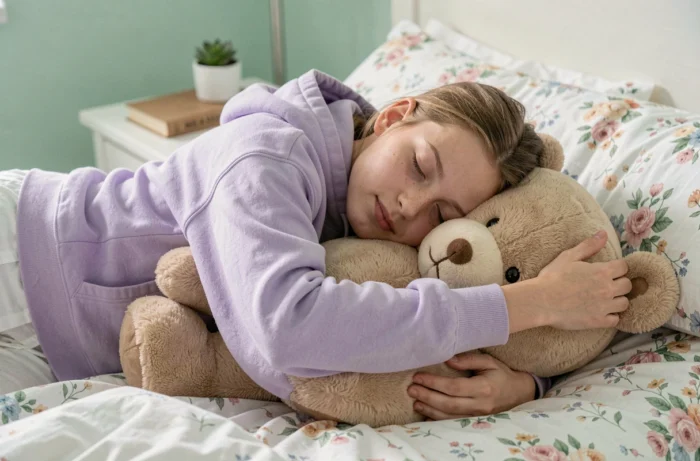
Safety recommendations based on research into weighted blankets advise against their use with infants and emphasize that users must be able to free themselves easily. The risk with a plush toy is lower than with a blanket covering the whole body, but it is not zero, particularly if the toy is placed on a very young child’s chest during sleep.
What to check before using a weighted plush toy
- The child or adult must be able to push the toy away without help, including while lying down. If its weight restricts movement or creates a feeling of pressure, it is too heavy for that user.
- The manufacturer should clearly state the total weight and recommended minimum age. If this information is missing, exercise caution.
- The filling (microbeads, sand, seeds) must be enclosed in a sewn inner pouch that is inaccessible to young children, to prevent any risk of ingestion.
- A weighted plush toy is not a substitute for professional care. It can be part of a relaxation routine, but it is not a treatment for clinical anxiety.
Choosing and using a weighted plush toy for everyday stress
Choosing a weighted plush toy depends less on its shape (animal, character) than on how its weight compares with the user’s build. For adults, a weight that is noticeable without feeling restrictive is generally a modest fraction of body weight. For children, the margin is narrower, and the manufacturer’s instructions should be followed.
The most appropriate use is for specific moments: coming home from work or school feeling tense, a restless period before falling asleep, or a quiet moment after sensory overload. Leaving the toy within easy reach so the child or adult can pick it up when needed works better than requiring its use at a set time.
What a weighted plush toy cannot do
It does not treat generalized anxiety disorder. It does not replace behavioral therapy or medical care. Its role is to provide sensory support, not treatment. Content that presents weighted plush toys as a complete solution for chronic anxiety oversimplifies a complex issue.
The weighted plush toy market is growing quickly, driven by appealing wellness messaging. The sensory benefits of weight and touch are real, but limited to what research has actually measured: moderate effects in specific contexts. Checking the weight, making sure the user can remove the toy independently, and keeping expectations realistic are the best ways to make good use of one.