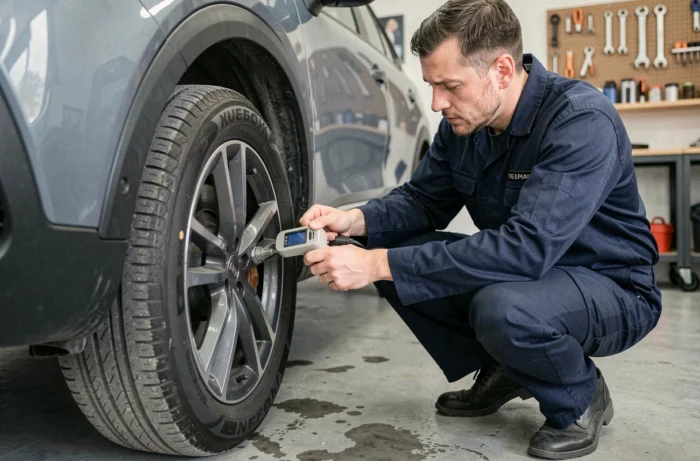
On a Peugeot 2008, the tire pressure warning light comes on after inflation, a wheel change, or sometimes for no apparent reason. The procedure for resetting the TPMS system varies depending on the vehicle’s generation and the type of onboard display. Understanding what differentiates these configurations helps avoid repeated attempts that resolve nothing.
Indirect or direct TPMS on Peugeot 2008: two systems, two logics
The Peugeot 2008 can be equipped with either an indirect or direct tire pressure monitoring system depending on the year and trim level. This distinction changes how the vehicle detects an anomaly, and therefore how the reset works.
| Criterion | Indirect TPMS | Direct TPMS |
|---|---|---|
| Measurement principle | Compares the rotation speed of the wheels via the ABS | Pressure sensors integrated into each valve |
| Reset | Vehicle menu on touchscreen or combined display | Learning process or diagnostic tool |
| Accuracy | Relative loss detection (difference between wheels) | Absolute measurement in bar or kPa per wheel |
| After wheel swap | Mandatory reset | Learning possible via specific tool |
An indirect system memorizes the reference conditions at the time of reset. If a tire is still under-inflated during this operation, the system takes this low value as a reference and loses reliability in detecting a subsequent loss.
To know which system is equipped on your Peugeot 2008, the manufacturer’s manual corresponding to the exact year of the vehicle remains the most reliable source. A procedure found for a first-generation 2008 does not necessarily apply to a facelifted model or a second generation.
Before any manipulation in the menus, it is recommended to reset the tire pressure on a Peugeot 2008 by following the sequence appropriate for your version to avoid errors.
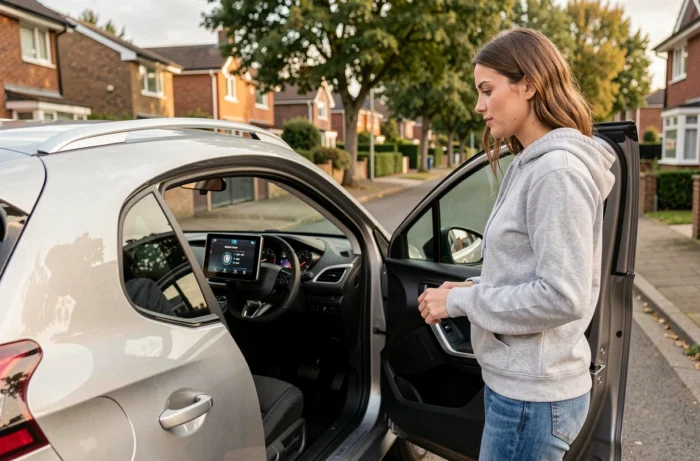
Tire pressure reset via the touchscreen: menu by menu
On most Peugeot 2008 models equipped with a touchscreen, the reset goes through the “Vehicle” menu. The classic sequence involves selecting “Vehicle,” then “Diagnostics and Control” or “Tire Pressure,” and finally confirming the reset.
The exact wording of the sub-menus varies. Some versions display “Initialization” where others indicate “Reset.” The ignition must be on, with the engine off or running depending on the models.
Conditions to meet before starting the procedure
- Check the pressure of each tire with a gauge, not by sight. The visual appearance of a tire does not confirm its actual pressure, a difference of several hundred grams can go unnoticed
- Inflate all four tires to the values recommended by the manufacturer (label visible on the driver’s side door pillar)
- Do not start the reset immediately after a long journey, as heat temporarily skews pressure values
- If the tires have just been swapped, the reset is mandatory on an indirect system to recalibrate the rotation references
Once these conditions are met, confirming in the menu records the new values. The warning light should turn off after a few minutes of driving, allowing the system to compare the data while moving.
Tire pressure warning light remains on after reset: diagnosing the causes
A warning light that persists after a correctly executed reset indicates a problem that the procedure alone cannot resolve. Restarting the reset multiple times without investigating the cause is akin to masking a symptom.
Slow leak or faulty valve
A slow puncture from a nail or a foreign object lodged in the tread gradually lowers the pressure. The tire can lose pressure over a few hours without visible signs. Applying a soapy water mixture to the surface of the tire and around the valve can help locate revealing bubbles.
The valves themselves wear out, particularly the O-rings. On a direct TPMS, a damaged valve sensor can send erroneous data to the ECU and keep the warning light on even if the pressure is correct.
System fault or sensor out of service
If the light flashes before staying on, the problem is generally related to the system itself rather than the pressure. A flashing light indicates a TPMS fault, not just a simple loss of pressure. In this case, a diagnosis with an appropriate tool (reading OBD fault codes) is necessary.
After a wheel or sensor replacement, a specific learning procedure may be required, sometimes only achievable in a workshop with a manufacturer tool.
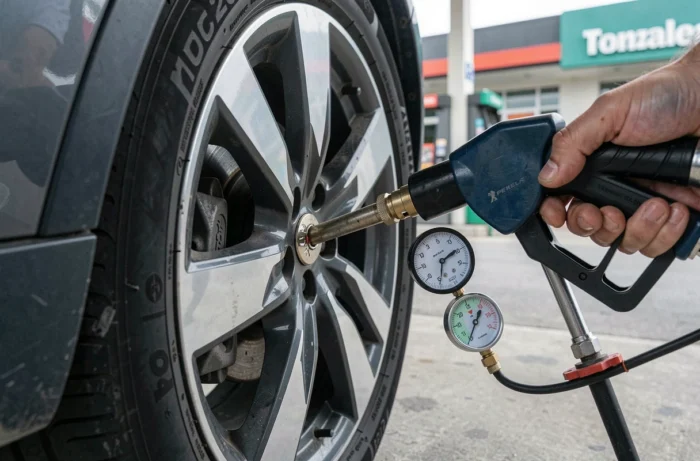
Recommended pressures and frequency of checks on Peugeot 2008
The recommended pressure values depend on the engine type, tire size, and vehicle load. The label affixed to the driver’s side door pillar indicates two sets of values: normal load and full load.
Consistently using the “full load” values as a precaution is a common mistake. Over-inflation degrades grip at the center of the tread and reduces the contact area with the ground, affecting braking.
Pressure should be checked when cold, meaning after at least two hours of inactivity or less than three kilometers driven at low speed. A monthly check with a reliable gauge remains the best prevention, the TPMS system does not replace regular manual checks.
A properly inflated tire according to the manufacturer’s recommendations wears evenly and consumes less fuel than an under-inflated tire. Resetting the warning light is only the last step in maintenance that begins with the gauge, not the touchscreen.