
Libéron’s 163 Faubourg range offers a velvet finish that sits between a true matte and a satin finish. Some products in the range feature a bio-based resin, the EU Ecolabel and an A+ indoor air quality rating, while other product listings mention the NF Environment label. These claims vary by shade and size, so check the tin or technical data sheet for the specific product you buy before assuming they apply across the range.
Product information recommends applying two coats for good coverage, and several user reviews confirm this. Reviews posted on retailers’ websites are mixed: some mention difficulty spreading the paint, visible roller marks and a lingering smell. These are the specific issues we set out to check on a real wall.
Preparing the wall before applying Libéron velvet paint: what affects the result
Leroy Merlin’s guidance for this range recommends washing the wall, rinsing it, then lightly sanding it and removing the dust. On an old satin or gloss finish, light sanding is recommended to improve adhesion. This process is not unique to Libéron, but it directly affects the final result.
On the wall we tested, which had an old light-colored matte finish, we washed it with diluted Saint-Marc cleaner, rinsed it with clean water, then left it to dry overnight. No sanding was needed because the existing finish was already matte. Surface preparation has as much impact on the result as the paint itself.
One point rarely mentioned in product information is that room temperature and humidity affect drying time between coats. In humid weather, you need to wait longer before recoating, and applying the second coat too soon can cause exactly the marks some users report.
We’ve published our review of Libéron velvet paint, including full details of the application conditions, for anyone who wants to compare them with their own surface.
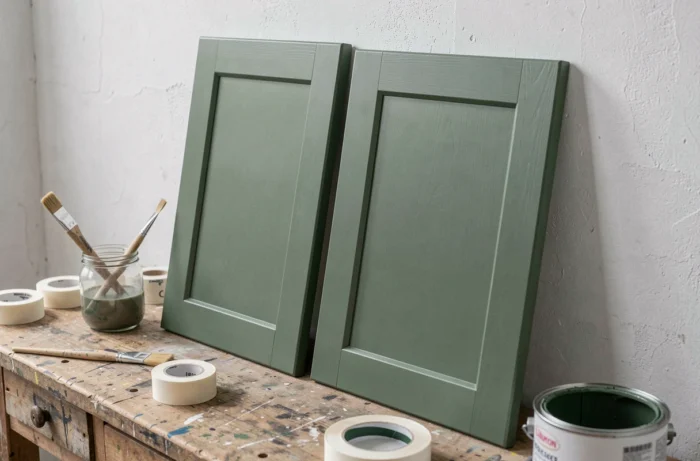
Velvet finish in raking light: the real test for this Libéron paint
The velvet finish differs from a deep matte finish in its very subtle sheen, which is only noticeable in raking light. That same light also reveals application flaws.
On the west-facing wall we tested, with a window to one side, the first coat showed uneven roller coverage. After the second coat, applied with crisscrossing strokes, the finish looked even in both direct and artificial light. However, at the end of the day, when sunlight skimmed across the wall, two areas showed slight variations in texture. These were the spots where we had gone back over the paint after reloading the roller.
This finding is consistent with user reviews that mention roller marks: the issue is not the paint itself, but the application technique. With a velvet finish, every time you go back over an area with the roller is more noticeable than it would be with a completely matte finish.
Touch-ups after drying
Three weeks after painting, we tried touching up a small area damaged by an impact. The fine-brush touch-up remained visible in raking light, even though we used the same paint from the same tin. To touch up a velvet-finish wall without leaving a visible line, you need to repaint the entire wall across its full width, from one corner to the other. This is worth bearing in mind before choosing this finish for a hallway or other high-traffic room.
Cleaning resistance and durability of velvet paint
After several weeks, we tested cleaning with a damp sponge on three types of marks: a fingerprint, a shoe mark near the bottom of the wall and a coffee stain from a splash.
- Fingerprints came off with a damp sponge without leaving a mark, as long as we didn’t scrub hard. A gentle wipe was enough.
- The shoe mark took a little more effort to remove. Rubbing slightly burnished the area, creating a sheen that differed from the rest of the wall and was visible in raking light.
- The coffee stain, wiped up within minutes of the spill, left no mark. However, a stain that had dried for several hours resisted cleaning and left a faint halo.
The velvet finish can handle light cleaning, but not vigorous scrubbing. Any area cleaned too forcefully may stand out from the rest of the wall because its sheen has changed.
Smell after application: a variable factor
Some Leroy Merlin reviews mention a lingering smell. In our test, the smell was noticeable on the day of application and the following day, then faded with normal ventilation. We kept two windows open during and after application. Ventilating the room for the first few hours seems to be key to preventing the lingering smell reported by some users.
Libéron velvet paint: which walls and uses is it suited to?
Based on our test, Libéron’s velvet finish is an attractive middle ground between matte and satin. It looks elegant and softer than a true matte finish, without the plastic-like look of satin.
This finish works well in living spaces that are not heavily exposed to knocks and dirt, such as bedrooms, offices and living rooms. For an entryway, hallway or child’s bedroom, the difficulty of touching it up and its sensitivity to scrubbing are real drawbacks.
The number of coats needed depends on the original wall color and the shade you choose. On a light-colored wall with a mid-tone shade, two coats are enough. On a dark background or with a very light shade, you may need a primer or a third coat. Product information does not always specify this, even though it can make a difference to the final cost.
A consistent finish depends more on careful application than on the product’s quality, which is reasonable for its price range. An experienced painter can achieve a flawless wall, while a beginner may see roller marks in raking light. This is not a product defect: it is simply the nature of a velvet finish, which is less forgiving than a fully matte one.