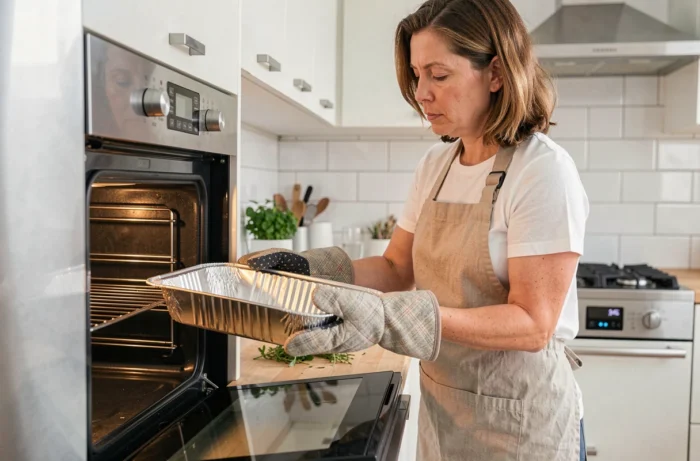
Food-grade aluminium can withstand a wide range of temperatures, from the freezer to a fan-assisted oven, but this raw heat tolerance is not what causes problems when reheating. The critical factor is the interaction between the food and the metal surface as the temperature rises.
Aluminium migration during reheating: factors that general-audience guides underestimate
Aluminium migration into food depends on three factors combined: the pH of the food, its salt content and the length of time it stays in contact with the metal at high temperatures. A neutral dish reheated briefly transfers virtually no aluminium. An acidic dish (tomato, citrus fruit, vinegar) or a highly salted one kept hot for several dozen minutes speeds up the process.
We find that most trays designed for reheating now have an internal coating (food-grade lacquer or varnish) that limits this transfer. Checking the “suitable for food contact” label on the packaging is not enough: you also need to make sure the coating is designed for the temperature range you intend to use.
European regulations require that the transfer of substances into food does not pose a health risk. In practice, this means that compliant trays used according to the manufacturer’s instructions meet the permitted limits. The risk arises when they are used for purposes they were not designed for: a container not intended for oven use, prolonged reheating of an acidic dish, or reusing a single-use tray.
To find out how to reheat an aluminium tray in the oven or microwave while taking these factors into account, the steps vary considerably depending on the appliance.
Aluminium tray in a conventional oven: temperature and positioning
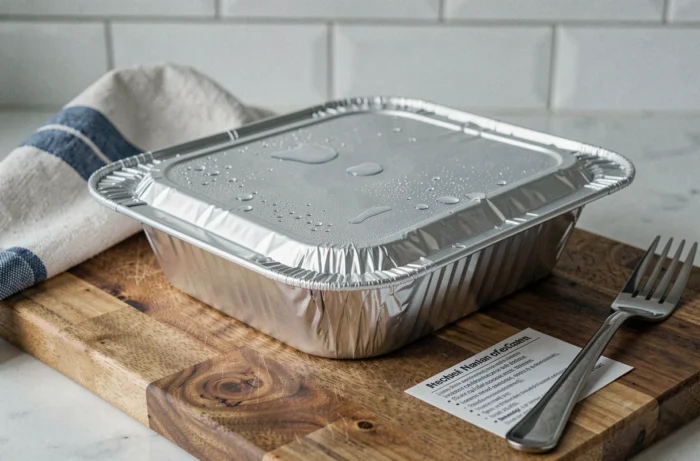
A conventional oven is the safest way to reheat food in an aluminium tray. Aluminium conducts heat evenly, helping food reheat consistently, provided you avoid a few common mistakes.
Settings to follow
- Remove the cardboard or plastic lid before putting the tray in the oven. An aluminium lid can stay on if the packaging says it is safe, but removing any components that are not heat-resistant is the first precaution.
- Use a moderate temperature, around 150 to 180 °C with fan-assisted heat. Fully preheating the oven before putting the tray in ensures the food heats up gradually.
- Place the tray on the middle rack, never directly on the oven floor. Direct contact causes the bottom of the tray to heat unevenly and may damage a protective coating.
- Cover the surface of the dish with aluminium foil if the food tends to dry out (gratins, meat in sauce). This reduces evaporation and helps preserve the texture.
Reheating in the oven should take no more than about 20 minutes for an individual portion. Any longer increases the risk of drying out the food, while extending the migration period unnecessarily, especially with acidic contents.
Aluminium tray in the microwave: strict precautions to prevent sparks
Putting aluminium in a microwave does not automatically cause an electrical arc or fire. Sparking (arcing) occurs when thin edges, folds or sharp points concentrate the electromagnetic field. A smooth, shallow tray with no crumpled edges may be compatible with some appliances.
Microwave compatibility applies to a specific package, not to aluminium in general. A tray bearing a microwave-safe symbol has been tested for this use. If there is no such indication, transferring the food to a glass or ceramic container is the only sensible option.
Microwave-specific precautions
Even with a microwave-safe tray, the shape of the container affects the results. A deep container heats less evenly than a shallow tray, because microwaves mainly reach the exposed surface. The centre of the dish may remain lukewarm while the edges are piping hot.
Follow these rules every time:
- Never cover the tray with a metal lid in the microwave. Use microwave-safe cling film with a few holes poked in it.
- Place the tray in the centre of the turntable and reheat only one tray at a time to avoid interactions between metal surfaces.
- Check that the appliance manual allows aluminium containers. Some manufacturers expressly prohibit them, even if the trays are certified.
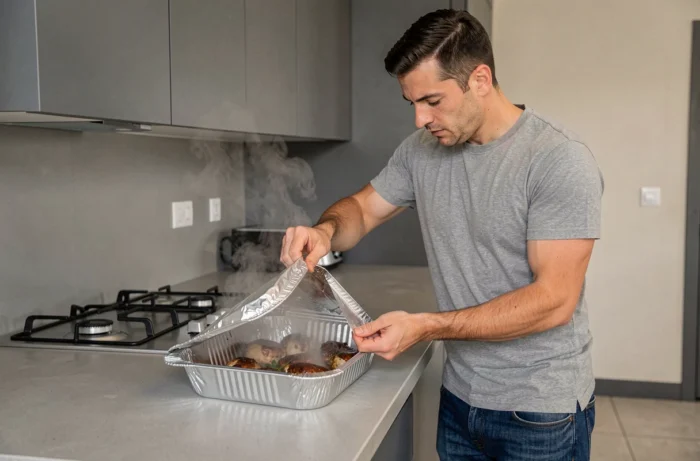
Foods to avoid reheating in an aluminium tray
Not every dish is suitable for reheating directly in its original tray. The deciding factor is not the type of aluminium, but the composition of the food.
Foods made with tomato, lemon, vinegar or wine have a low enough pH to speed up migration, especially when heated for a prolonged period. Chili con carne, ratatouille and fish marinated in lemon all fall into this category.
Very salty foods (reheated cured meats, gratins made with highly salted cheese) pose a similar problem. Salt acts as a corrosion catalyst on uncoated aluminium surfaces.
In these cases, transferring the food to a borosilicate glass or ceramic dish before reheating eliminates the problem. It takes just a few seconds and removes any uncertainty about migration.
Reuse and storage: what recycling cannot fix
A single-use aluminium tray is not designed for repeated reheating. The internal coating deteriorates, micro-scratches appear and the surface loses its barrier properties. Reusing a disposable tray for a second round of reheating removes the protection that made the first use safe.
Storing food in its original tray in the refrigerator is acceptable for a short time (one to two days), provided you cover the dish to limit surface oxidation and contact with other foods. Do not store an acidic dish for more than a few hours in an uncoated aluminium container.
Recycling the tray after use is good environmental practice, but it does not make up for improper use at high temperatures. A container that has been used to reheat acidic food for too long has already transferred some of its material into the dish, whether or not the tray is subsequently recycled.