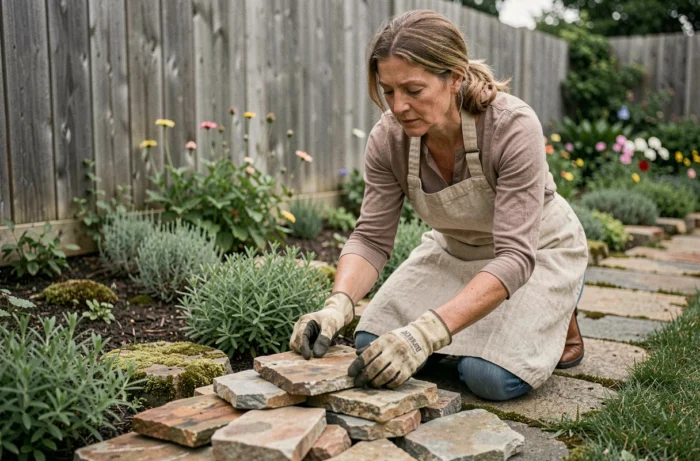
Landscaping a garden with natural stone creates a sturdy, long-lasting result. The problem is the cost: buying stone from a garden center or supplier can quickly get expensive, especially when you need a large quantity. The good news is that there are several ways to find free stones near you, as long as you know where to look and follow a few simple rules.
Salvage stones from demolition sites
Have you ever noticed piles of rubble and stones building up outside a house being renovated? For the contractor, these materials are waste that needs to be removed. For you, they’re a free resource.
When an old building is demolished or a wall is taken down, the stones are often still in good condition. Rubble stones, cut stone, and pieces of low walls can all be used to build an edging, create a rock garden, or pave a path.
Always get permission from the owner or site manager before taking anything. This isn’t just a matter of courtesy. Regulations distinguish between reuse (the material remains a product) and recovery (the material has become waste). Taking materials without permission may be considered theft or illegal waste collection. Verbal permission is often enough, but confirming it by text message or email protects both parties.
The easiest way to find these sites is to drive around your area and note down the addresses. Residential neighborhoods undergoing renovation are particularly good sources of reusable stone. Once you know where to find free stones, all that’s left is to arrange transportation.
Free listings from individuals: platforms and local groups
Construction sites aren’t the only source. Many people want to get rid of stones, pebbles, or rubble after doing work on their homes. They post free listings on classified ad platforms or local Facebook groups.
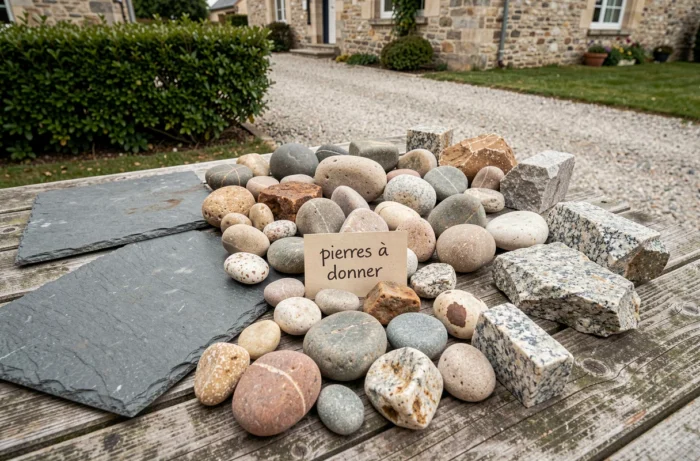
On Leboncoin, searching for “pierre à donner” in the Garden & Plants category regularly brings up free offers, with pickup required. Similar sites in Belgium, such as 2ememain, have the same kinds of listings. Local town or community Facebook groups are also very effective: a post like “FREE – stones and pebbles” often gets several replies within a few hours.
Post your own request
Rather than waiting for the right listing, post your own request for free stones. Include your town, the type of stones you’re looking for (flat, round, large, small), and mention that you can collect them. This matters: most people giving stones away simply want someone to come and take the pile away.
- Leboncoin, under “Garden & Plants,” with the “Free” filter or a price of zero: France’s largest source of free stones for collection
- Facebook groups for your town or local community: ideal for quick, location-based exchanges
- Free item apps (Geev, Donnons.org): fewer stones available, but targeted offers appear regularly
Public land and natural areas: what’s allowed
Collecting stones in nature may seem like an obvious option, but you can’t collect them freely everywhere. Municipal land, riverbanks, and forest paths are all subject to different regulations.
On municipal public land (paths, ditches, embankments), collecting a few stones for personal use is generally tolerated. However, taking large quantities or using mechanical equipment requires permission from the town hall.
Areas where you must not collect stones
Protected sites, nature reserves, and riverbeds are off-limits. Removing stones from a riverbed alters the ecosystem and may result in penalties. Beaches are also covered by these rules: collecting pebbles is prohibited in most coastal towns.
Contact your town hall before collecting anything from public land. A quick call to the public works department will tell you what’s allowed locally. Some towns even make piles of stones or fill material from roadworks available to residents.
Transporting and sorting salvaged stones
Finding free stones is only half the job. The other half is getting them home. Transport is often the hidden expense when collecting heavy materials.
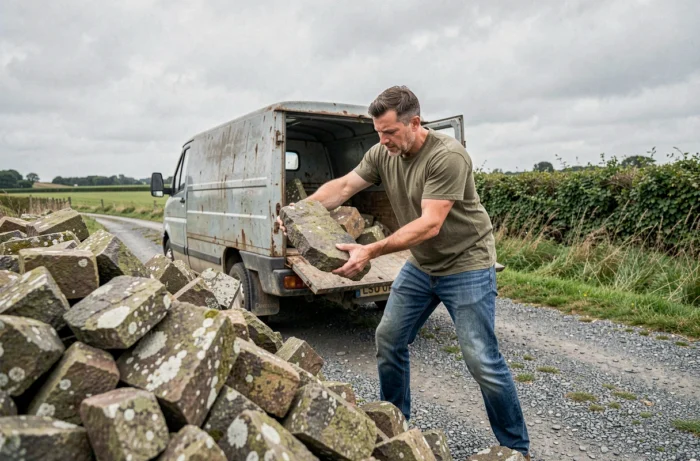
A standard car trailer can usually carry a few hundred kilos. For larger quantities, renting a flatbed van is still the most economical option. Check your vehicle’s maximum authorized weight before loading it.
Sort the stones before laying them
Once the stones are home, it’s time to sort them. Not every salvaged stone is suitable for every use.
- Flat, regular stones: perfect for a patio or stepping stones across a lawn
- Rubble stones and irregular stones: suitable for retaining walls, garden bed edging, or rock gardens
- Large stones and pebbles: useful as mineral mulch around plants or for draining a wet area
- Mixed rubble (concrete, brick, stone): use only as a base for a path or to fill a pit, never on a visible surface
Sorting stones by size and shape as soon as you unload them saves a lot of time when it’s time to lay them. A well-sorted pile also means you won’t have to handle the same blocks more than once.
Finding free stones for your garden takes time, a suitable vehicle, and a few extra steps. It’s worth the effort: natural stone landscaping ages well, requires no maintenance, and ultimately costs little more than a bit of hard work.