
A food blog that has been publishing recipes for several years can accumulate hundreds of pages. Finding a specific recipe among all that content calls for a navigation tool that goes beyond the main menu. When designed as a navigation page rather than just a technical file, the sitemap becomes the most direct way to find content without having to hunt for it.
XML Sitemap and HTML Sitemap: Two Tools with Different Purposes
Confusion between these two formats explains why many food blogs fail to make the most of their sitemap. An XML sitemap is a file intended for search engine crawlers. Google says it helps them discover URLs, but does not guarantee that those URLs will be crawled or indexed. This file has no direct use for human readers.
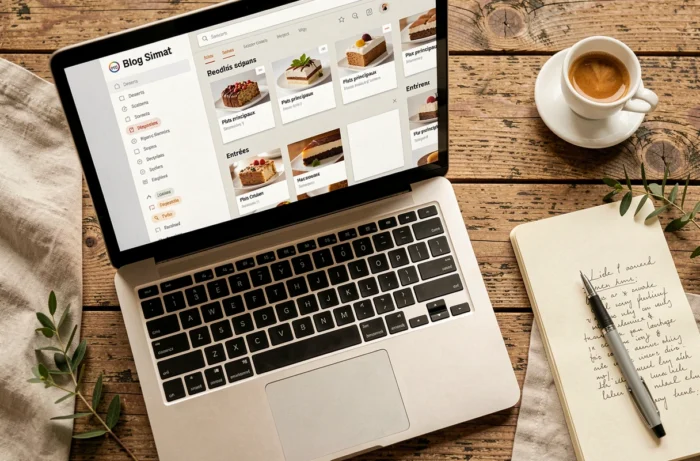
An HTML sitemap, on the other hand, is a page visitors can browse. It lists the blog’s content as clickable links, organized by category. This is the page that helps visitors find their way around.
| Criteria | XML Sitemap | HTML Sitemap |
|---|---|---|
| Primary audience | Search engine crawlers | Blog readers |
| Format | XML file that is not easy to read | Web page with clickable links |
| SEO role | Signals URLs to crawl | Strengthens internal linking |
| Navigation role | None for visitors | Central access point to content |
| Updates | Automatic (plugin or CMS) | Manual or semi-automatic |
A successful food blog uses both. The XML works behind the scenes for search engines, while the HTML gives readers a clear point of reference. On the Mon Blog Cuisine sitemap, you can see this approach in action: a page organized by category and accessible directly from the footer.

Navigation by Food Category: Structure the Sitemap as an Editorial Guide
A sitemap that simply lists articles by publication date misses the point. Nobody searches for “the recipe published on March 14.” Visitors to a food blog think in terms of dish type, ingredient, or dietary requirement.
Categories That Match Real Searches
The most effective way to organize a food blog sitemap is to follow the reader’s logic, not the blogger’s. Three complementary ways to group content work well:
- By meal type (starters, main courses, desserts, appetizers) — the most intuitive approach and the one most visitors expect to see first
- By main ingredient (chicken, salmon, lentils, chocolate) — useful when readers check their fridge before visiting the blog
- By diet or dietary requirement (gluten-free, vegetarian, low-sugar) — a growing search category that few sitemaps explicitly include
A sitemap that offers these three ways to browse turns a simple list of links into a self-service search tool. Visitors no longer need the search bar to find their way around.
Clear Labels Instead of Generic Names
Navigation recommendations based on Baymard’s research emphasize one key point: labels should make sense out of context. A link titled “Recipes for potato gratin and tartiflette” is more informative than one titled “Category 7.” On a sitemap, each label works as a mini-summary of the content it links to.
Sitemap Accessibility: A Criterion Often Overlooked by Food Blogs
A sitemap made entirely of explicit HTML links offers a technical advantage rarely mentioned in food blogging guides: it remains navigable by keyboard and assistive technologies. Screen readers can move through the list of links without relying on hover effects or JavaScript dropdown menus.
WCAG 2.2 recommendations place greater emphasis on keyboard focus being visible and unobscured. A static sitemap structured as HTML lists with descriptive anchor text meets these requirements by default. Main navigation menus, with their nested submenus and animations, tend to present more accessibility challenges.
For a food blog, this means the sitemap is not a duplicate of the menu: it is the only page that guarantees full access to the content without technical barriers. Visitors who navigate by keyboard, or whose mobile connection limits script loading, can access every recipe from this page.
Internal Linking and SEO: How a Sitemap Helps Recipe Pages
An HTML sitemap contributes to a blog’s internal linking. Every link on the page sends search engines a signal about the site’s structure and content hierarchy. A recipe that can be reached in one click from the sitemap is more likely to be crawled than one buried five scrolls down an archive page.
This benefit is indirect. Google does not guarantee that a URL will be crawled or indexed simply because it appears in a sitemap. The benefit comes from reducing click depth: when every recipe is linked from a central page, none is more than two clicks away from the homepage.
Food blogs that publish several recipes a week see older content sink into the archives. A sitemap keeps those pages permanently accessible, preventing them from becoming orphan pages that are invisible to search engines.
Update the Sitemap After Every Publication
An HTML sitemap that does not include the latest recipes no longer serves its purpose. There are two main approaches:
- Manual updates, which are reliable but demanding for blogs that publish frequently
- Automatic generation through a CMS plugin, which adds each new piece of content to the right category without any manual work
- A hybrid system in which categories are defined manually, while articles are automatically assigned to them based on their tags
The right choice depends on publishing volume. A blog that publishes two recipes a month can manage its sitemap manually. With more than eight posts a month, automation helps prevent the oversights that create orphan pages.
A food blog’s sitemap is not a secondary page to tuck away in a corner of the footer. It is a practical navigation tool, a way to strengthen internal linking, and a guarantee of accessibility. The difference between a blog where you can find a recipe in ten seconds and one you give up on after three clicks often comes down to this one page.