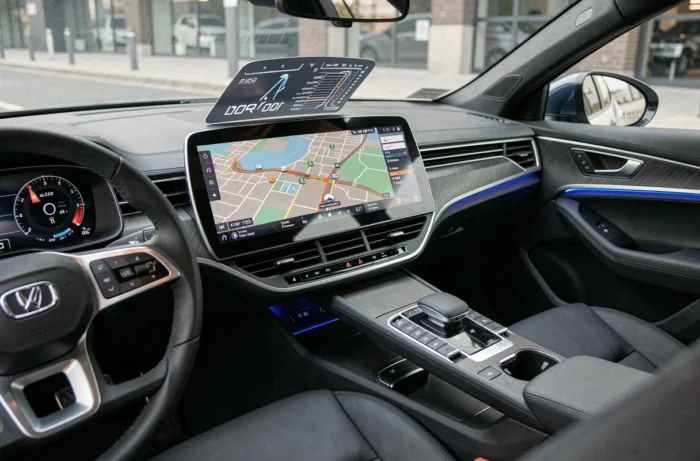
Driver assistance systems (ADAS) are becoming increasingly common in new vehicles sold in Europe, driven by the General Safety Regulation and Euro NCAP protocols. This growing technological complexity is fundamentally changing the interface between drivers and their vehicles—not always making it simpler.
Cabin sensors and Euro NCAP 2026 protocols: what’s changing inside the car
The Euro NCAP 2026 protocols place greater emphasis on monitoring driver attention and occupant safety. Detecting children left inside a vehicle is now a separate assessment criterion, prompting manufacturers to integrate cabin sensors that combine cameras and radar.
This camera-radar combination can detect someone even when they are not moving, unlike purely optical systems, which become less reliable when an occupant is still or covered. Manufacturers are combining these functions in a single module, often housed near the rear-view mirror or in the overhead console.
For drivers, the direct consequence is continuous monitoring of their gaze and posture. The system can trigger audible or visual alerts if they look away from the road for too long, even when using adaptive cruise control. We have found that this layer of monitoring, designed to improve safety, can also generate nuisance alerts when drivers adjust their mirrors or look for an object on the passenger seat.
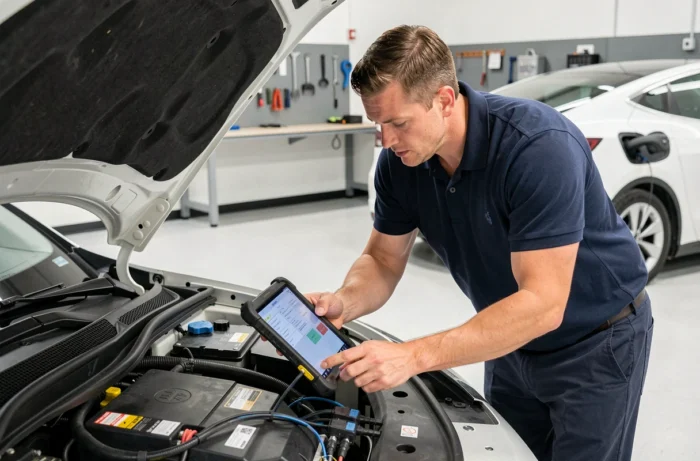
The challenge for suppliers is to calibrate the activation thresholds. Set the threshold too low and the system produces irritating false positives; set it too high and it becomes ineffective. Real-world feedback shows that how drivers respond to assistance systems depends as much on calibration as on the technology itself. Even a technically capable system will be switched off within the first few weeks if it is poorly calibrated.
European Data Act and connected vehicle data: a turning point for automotive after-sales
The issue extends well beyond the cabin. Since September 12, 2025, the European Data Act has provided that users of connected products, including cars, can access the data those products generate and share it with a third party of their choice. Specialist resources covering these developments are available at https://www.auto-hightech.fr, which explores the intersection of automotive and in-vehicle technologies.
For vehicles placed on the market after September 12, 2026, the Data Act requires data to be accessible by default, in a usable format and, where technically possible, directly. This obligation changes the landscape for independent repair shops, insurers and fleet managers.
Until now, telemetry data (actual mileage, fault codes, braking history and real-time fuel consumption) has remained locked within manufacturer networks. Open access allows an independent repairer to diagnose a vehicle without using proprietary tools, and enables insurers to offer pricing based on actual usage.
However, access arrangements vary by manufacturer. Some already offer documented APIs, while others provide only a web portal with CSV exports. Data formats and levels of detail have yet to be standardized, hindering interoperability.
Mandatory assistance systems and cognitive load: when automotive technology makes driving more complicated
The General Safety Regulation has made several systems mandatory in new vehicles sold in Europe: automatic emergency braking, lane departure warning, Intelligent Speed Assistance (ISA) and driver drowsiness detection. On paper, each feature reduces a specific risk. In practice, having them all at once creates a layer of interactions that drivers must manage continuously.
- ISA (Intelligent Speed Assistance) relies on sign recognition and map data. In roadworks or on roads where temporary signs conflict with GPS data, the system may suggest an incorrect speed limit, forcing the driver to correct it manually.
- Lane departure warning sometimes activates on narrow roads without clear markings, or when the driver swerves to avoid an obstacle. The frequency of false positives varies by model and driving conditions.
- Automatic emergency braking may react to harmless objects, such as a metal bridge or a cast shadow, causing unexpected deceleration. These cases are rare but memorable for drivers.
Some drivers find mandatory assistance systems poorly calibrated or too intrusive. Drivers’ tendency to switch them off is well documented, particularly for ISA and lane departure warning, which many disable as soon as they start the car. This behavior undermines the safety benefits the regulations are intended to deliver.

The problem is not the technology itself, but the lack of fine-grained customization. ADAS settings are often buried in infotainment submenus and labeled unclearly. Drivers who can’t find the right setting end up switching everything off.
Autonomous vehicles: a geographically limited rollout, not widespread adoption
Real-world autonomous vehicle projects remain confined to specific geographic areas and subject to rigorous evaluation. Several French cities have put themselves forward to take part in a European testing project in 2026, illustrating a gradual, region-by-region approach to deployment.
The move from Level 2+ (assistance with continuous driver supervision) to Level 3 (delegated driving under defined conditions) represents a legal as well as a technical leap. The driver shifts from supervisor to temporary passenger, raising questions of liability that national regulatory frameworks have yet to resolve fully.
For everyday driving, the practical impact remains limited to Level 2 features: adaptive cruise control, lane centering and parking assistance. These features are now available on mid-range models from most European and Asian manufacturers.
The growing number of in-vehicle assistance systems is changing the relationship between drivers and their vehicles without necessarily making it simpler. The challenge in the years ahead lies less in adding features than in integrating them coherently, with interfaces that help drivers understand what the system is doing, why it intervenes and how to adjust it.
The Data Act, Euro NCAP protocols and real-world user feedback all point to the same requirement: put the driver back at the center of the loop, even when it comes to systems designed to protect them.