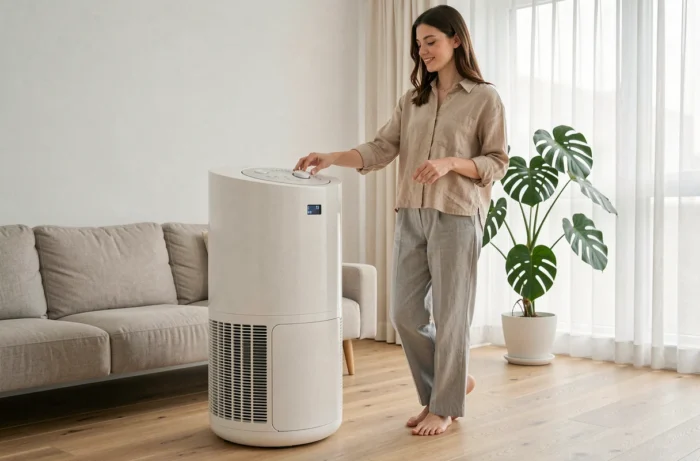
A 15 m² attic room with a tilt-and-turn window open by ten centimetres: this is the kind of setup in which the Klarstein Highrise shows both its strengths and its limitations.
With a slim footprint of 24 cm in diameter and a height of 90 cm, this air cooler fits where a conventional tower fan would already struggle. The question is whether its evaporative cooling lives up to its promises when natural ventilation is limited.
Klarstein Highrise air cooler in a poorly ventilated bedroom: what really makes a difference
You’ll often read that the Highrise is suitable for rooms with a volume of 45 m³, or around 20 m². This manufacturer’s figure assumes a minimum level of air circulation in the room. In a properly ventilated bedroom (with the window open and a light draught), water evaporation lowers the perceived temperature by a few degrees, and the effect is noticeable from the first fan speed.
The problem arises when the room is closed or nearly closed. The physics is simple: the appliance adds moisture to the surrounding air. If that moisture cannot escape, it builds up and the cooling benefit diminishes. In already humid air, the Highrise works more like a fan-humidifier than a true air cooler. It’s therefore best to keep at least one opening, even a narrow one, to ensure sufficient air exchange.
Our review of the Klarstein Highrise air cooler reaches the same conclusion: the appliance provides genuine comfort in the right conditions, but it cannot replace an air conditioner that removes heat from the room.
Using the Klarstein Highrise and its everyday features
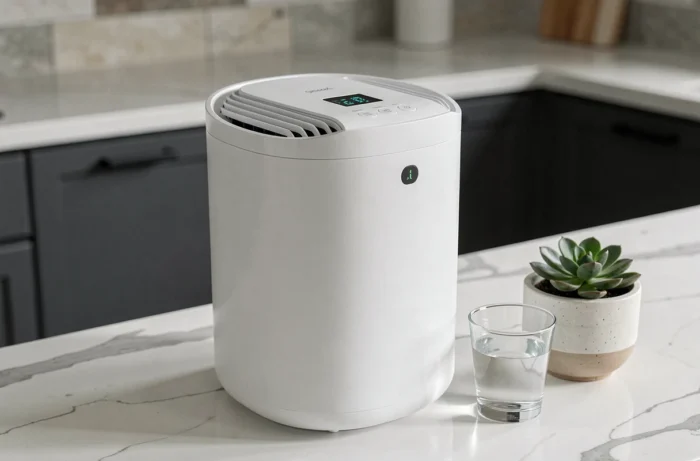
The appliance offers three fan speeds, an oscillation mode and a programmable timer. The included remote lets you control everything from your bed or sofa, so you don’t have to get up at night to adjust the airflow. The control panel remains backlit at all times, which is one of the few recurring complaints: the LEDs stay on even in night mode, which can bother people who are sensitive to light.
Filling the tank and routine maintenance
The tank is fixed in place. Fill it from the top using a jug or bottle. Adding ice packs to the water enhances the cooling sensation, but you’ll need to plan ahead: once the ice has melted, the appliance goes back to operating like a standard fan-humidifier.
- Clean the tank every two weeks to prevent limescale deposits and mould, especially with regular use.
- Check the mesh filter that traps impurities: a clogged filter reduces airflow and therefore the perceived cooling effect.
- Empty the tank completely if the appliance will be unused for more than a few days, to prevent the water from stagnating.
Maintenance takes less than ten minutes and directly affects the quality of the air it blows. A neglected tank can spread unpleasant odours around the room.
Power consumption and noise: the Highrise compared with a portable air conditioner
With a stated power consumption of around 35 to 40 watts, depending on the source, the Klarstein Highrise uses a fraction of the power required by a portable air conditioner (often ten to twenty times more). Over a full night of operation, the difference on your electricity bill is clear—an important selling point for anyone looking for an appliance they can run for hours without worrying about the cost.
At low speed, the Highrise is quiet. At maximum speed, the airflow becomes more noticeable, comparable to that of a mid-range tower fan. At low speed, it’s quiet enough for most people to sleep, provided they can tolerate a slight, continuous background noise.
Air cooler or air conditioner: which should you choose?
There’s still confusion between these two categories. An evaporative cooler like the Highrise has no compressor, refrigerant gas or exhaust hose. It doesn’t remove heat; it temporarily masks it through water evaporation. In a well-ventilated room and a dry climate, the results may be enough. In a poorly ventilated apartment during a humid heatwave, an air conditioner is the only solution that will genuinely lower the temperature.
The Highrise is a compromise for homes where installing a fixed air conditioner isn’t possible (rented accommodation or restrictive building rules) and where the budget rules out a portable air conditioner.

Klarstein Highrise value for money: who is this appliance for?
The Highrise first catches the eye with its design. The white or black tower blends into a home without looking out of place, unlike many air coolers with a more industrial style. This aesthetic matters when the appliance stays on display all year in a living room or bedroom.
- Suitable for modest-sized spaces (a studio, bedroom or small office) with at least some natural ventilation.
- A good option for people looking for an appliance that is quiet, programmable and energy-efficient.
- Less suitable for large open-plan rooms or homes in areas with high summer humidity, where evaporation is less effective.
The stated airflow (around 500 m³/h, according to the most detailed competitor) puts the Highrise in the upper-middle range of its category. This figure doesn’t guarantee even cooling: ambient humidity and air circulation in the room matter just as much as airflow. A hygrometer costing just a few euros can help you check whether conditions are suitable before you buy.
The Klarstein Highrise is neither a gimmick nor a disguised air conditioner. It’s a well-designed fan-humidifier that performs well within its limits. In a 10–20 m² bedroom with an openable window, it provides a noticeable boost in comfort on summer nights. Outside these conditions, it’s better to consider a more powerful solution.